
What Are the Benefits of Women-Owned Businesses?
Women-owned businesses may benefit from specialized funding resources, federal contracting opportunities, supplier diversity programs, professional networks, mentorship, training, and increased marketplace visibility. Some opportunities require formal certification, while others are available more broadly to women entrepreneurs.
Women-owned businesses continue to play an important role in the U.S. economy, creating jobs, serving communities, and bringing new perspectives to industries of all kinds.
But building a successful company takes more than a strong idea. Women entrepreneurs often need access to the right funding, professional relationships, resources, and opportunities to help their businesses grow.
At She’s A Given, we work closely with founders, executives, and business owners who are balancing leadership with the day-to-day demands of running an organization. We see firsthand how valuable the right support, connections, and resources can be when a business reaches its next stage of growth.
The good news is that there are several programs and opportunities specifically designed to support women entrepreneurs.
Here are seven benefits and opportunities women business owners should know about in 2026.
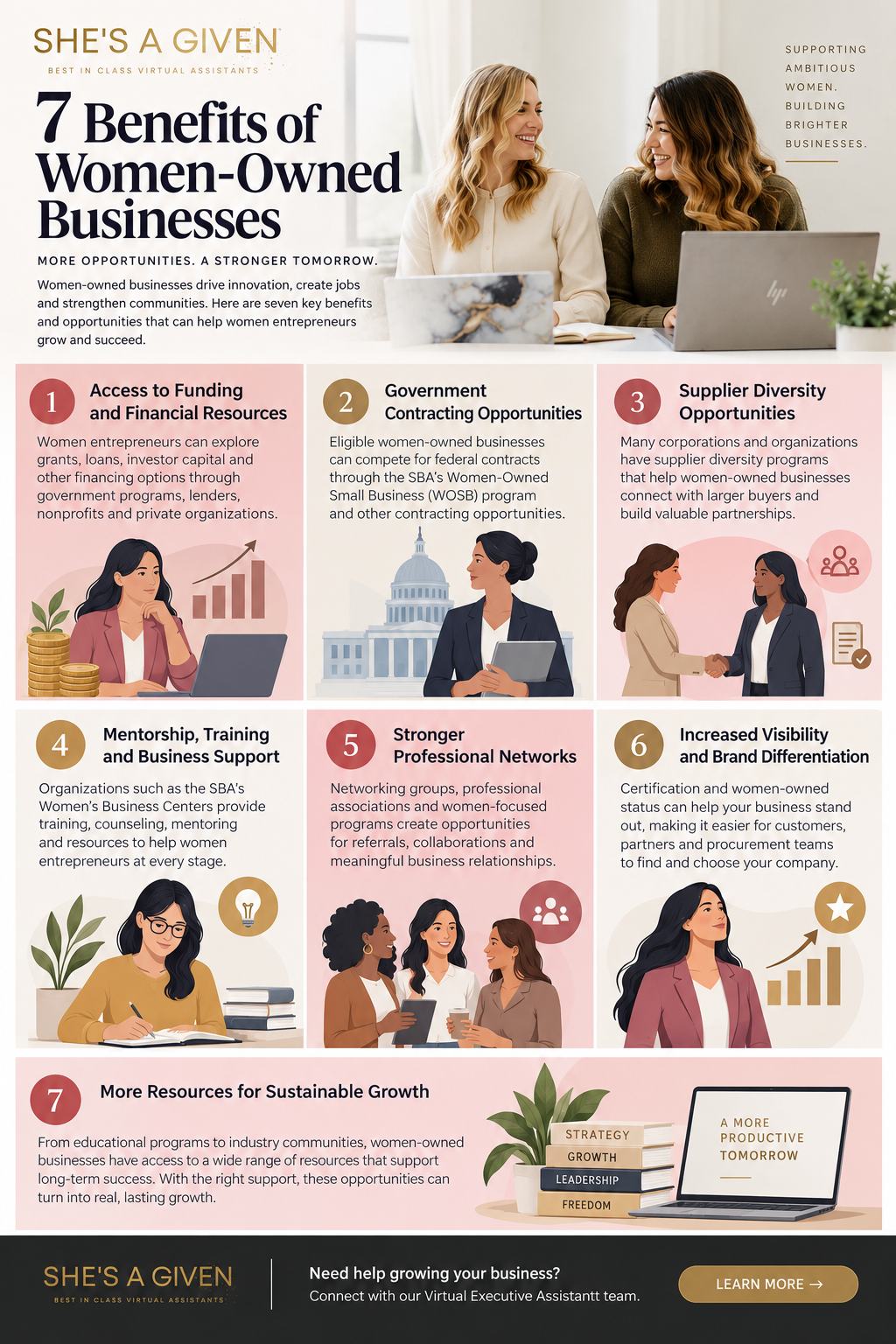
Access to Funding and Financial Resources
Access to capital is one of the biggest considerations for almost any growing business. Women entrepreneurs can explore financing and funding resources offered through government programs, lenders, nonprofit organizations, private companies, and organizations focused on supporting women in business.
The U.S. Small Business Administration's Office of Women’s Business Ownership, for example, connects women entrepreneurs with programs that include access to credit and capital, along with business training, counseling, and federal contracting resources.
Women business owners may also find private grant competitions and other funding opportunities created specifically for entrepreneurs. Availability and eligibility change frequently, so it is important to verify requirements directly with the organization offering the funding.
It is also worth remembering that a grant is only one form of funding. Depending on your goals and qualifications, loans, investor capital, lines of credit, and other financing options may be worth exploring.
Government Contracting Opportunities
Another potential advantage for qualifying women-owned businesses is access to federal contracting opportunities.
The SBA's Women-Owned Small Business Federal Contract program, commonly called the WOSB program, helps eligible women-owned small businesses compete for federal contracts in industries where women-owned businesses are underrepresented. Some contracts are specifically set aside for certified WOSBs or Economically Disadvantaged Women-Owned Small Businesses (EDWOSBs).
To qualify for the WOSB program, a company generally must meet SBA small-business standards, be at least 51% owned and controlled by women who are U.S. citizens, and have women managing day-to-day operations and making long-term decisions.
Certification does not guarantee that your company will win government contracts. It can, however, make an eligible business able to compete for contracting opportunities reserved for certified participants.
For women entrepreneurs interested in government work, this can create another potential avenue for business development.
Supplier Diversity Opportunities
Government contracting is not the only place where women-owned businesses can find new opportunities.
Many corporations and other organizations maintain supplier diversity programs designed to broaden the range of businesses included in their supply chains. Women-owned businesses that meet a program's requirements may be able to participate in procurement opportunities that introduce them to larger organizations and new business relationships.
Depending on the program, formal certification may be required.
The value goes beyond simply being included in a directory. Supplier relationships can introduce a growing company to decision-makers, procurement teams, partnerships, and markets that may otherwise be difficult to reach.
For women business owners looking to expand into B2B markets, supplier diversity can therefore become part of a broader business development strategy.
Mentorship, Training, and Business Support
Running a company requires decisions about hiring, finances, marketing, operations, technology, leadership, and growth. No founder needs to figure out every one of those areas alone.
Women entrepreneurs can access mentorship and business development resources through organizations such as the SBA's network of Women’s Business Centers (WBCs).
These centers provide services such as counseling, training, technical assistance, networking, and mentoring on business topics ranging from startups and financial management to marketing and procurement.
That kind of support can be particularly useful when your company is entering a new phase.
A business owner who handled nearly everything herself in the early stages may eventually need new systems, stronger processes, additional expertise, or a team that can take ownership of responsibilities she no longer needs to manage personally.
That transition is often part of healthy growth.
Stronger Professional Networks
One of the most valuable benefits of being part of the women-owned business community is access to people who understand many of the challenges that come with entrepreneurship and leadership.
Networking groups, professional associations, local business organizations, conferences, and women-focused entrepreneurial programs can help owners build relationships with:
Other founders and business owners
Potential clients and partners
Mentors and advisors
Vendors and service providers
Professionals with complementary expertise
The goal is not simply to collect contacts.
Strong business relationships can lead to referrals, collaborations, introductions, advice, and opportunities that might never come through a traditional marketing channel.
For busy founders, the challenge is often finding enough time to maintain those relationships while still running the company. This is one reason delegation and executive support become increasingly important as a business grows. When administrative responsibilities are handled effectively, leaders have more capacity for the conversations and relationships that require their direct involvement.
Increased Visibility and Brand Differentiation
Being a women-owned business can also be part of your company's larger brand story.
Customers, prospective partners, corporations, and procurement teams may actively look for businesses with diverse ownership. Appropriate certification can also make it easier for organizations searching for qualified women-owned suppliers or contractors to identify your company.
But women-owned status should support your positioning, not replace it.
Clients still want expertise, reliability, quality, and results.
The strongest approach is to communicate your company's ownership authentically while continuing to build a brand around what you do exceptionally well.
That combination can help distinguish your business without making your identity the only reason someone chooses to work with you.
More Resources for Sustainable Growth
Perhaps one of the most overlooked benefits of women-owned businesses is access to an ecosystem of organizations, programs, educational resources, and professional communities focused on helping women entrepreneurs build stronger companies.
The SBA's Office of Women’s Business Ownership coordinates programs that provide women entrepreneurs with business training, counseling, access to credit and capital, and federal contracting opportunities.
The important question is what you do with those resources.
As opportunities increase, so does the workload behind them. Applications need to be completed. Meetings need to be scheduled. Prospects require follow-up. Projects need coordination. Relationships need attention. Leaders need enough uninterrupted time to make strategic decisions.
This is where having the right support structure matters.
At She’s A Given, we help leaders reclaim their time with experienced Virtual Executive Assistants who can take ownership of administrative and operational responsibilities that otherwise compete for an executive's attention.
Growth should create opportunities for the leader, not simply a longer to-do list.
From Our Experience Supporting Business Owners
Working with founders and executives has shown our team something important: opportunity alone does not create sustainable growth.
Leaders also need the capacity to act on that opportunity.
A new partnership is only valuable if someone follows through. A growing client base requires organization. More meetings require calendar management. Bigger projects create more communication, documentation, and coordination.
For many business owners, learning what to delegate to a Virtual Executive Assistant is an important part of making that transition.
The right support allows a leader to spend less time managing recurring administrative demands and more time on the work that requires her judgment, expertise, relationships, and vision.
Turning Opportunity Into Growth
The advantages available to women-owned businesses can open valuable doors, but every program has different eligibility requirements, and not every opportunity will be right for every company.
Start by identifying what your business actually needs.
If capital is the priority, explore reputable funding and financing resources. If government work aligns with your services, investigate WOSB certification and contracting requirements. If connections and expertise are the priority, look for Women’s Business Centers, professional organizations, and mentorship opportunities relevant to your industry.
And if your business is growing faster than your available time, consider whether some of the work currently sitting on your plate still requires you to be the person doing it.
She’s A Given provides Virtual Executive Assistant services for founders and executives who are ready to delegate with confidence and create more room for strategic leadership.
Because having more opportunities is valuable. Having the time and support to pursue them is what helps turn those opportunities into meaningful growth.
Frequently Asked Questions About Women-Owned Business Benefits
What are the main benefits of a women-owned business?
Women-owned businesses may have access to specialized funding resources, federal contracting opportunities, supplier diversity programs, professional networks, mentorship, training, and business development support. Some benefits require certification or have specific eligibility requirements.
Do women-owned businesses get tax breaks?
Being a women-owned business does not automatically provide a federal tax break simply because the business is owned by a woman. However, a business may qualify for federal, state, or local tax incentives based on factors such as location, industry, hiring, investment, or other eligibility requirements. Business owners should verify current requirements with the appropriate government agency or a qualified tax professional.
Are there grants for women-owned businesses?
Funding opportunities for women entrepreneurs are available through some government initiatives, nonprofit organizations, corporations, foundations, and private grant programs. However, not every SBA program described as a “grant” provides money directly to individual businesses. For example, SBA funding for Women’s Business Centers supports organizations that provide services to entrepreneurs. Business owners should always check the eligibility requirements and source of a grant before applying.
What advantages does women-owned business certification provide?
For eligible businesses, SBA WOSB certification provides access to compete for certain federal contracts set aside for certified Women-Owned Small Businesses. SBA notes that WOSB certification benefits apply specifically to federal contracting rather than private-sector opportunities. Other women-owned certifications may serve different purposes, including supplier diversity programs, so businesses should choose certification based on the opportunities they want to pursue.
How can a Virtual Executive Assistant help a women-owned business grow?
A Virtual Executive Assistant can take ownership of recurring administrative and operational responsibilities such as calendar management, communication, research, documentation, and project coordination. This can give a founder or executive more time to focus on leadership, clients, partnerships, business development, and strategic growth.
Ready to Create More Room for Growth?
Your business may have more opportunities ahead, but you do not have to manage every detail yourself.
At She’s A Given, our Virtual Executive Assistants provide experienced executive-level support designed to help busy leaders protect their time, stay organized, and focus on their highest-value priorities.
Ready to take your business to the next level? Schedule a Discovery Call and let’s begin building the support you deserve. We can’t wait to work with you.
