
Can AI Replace a Virtual Assistant? What Founders Should Automate, Delegate, and Keep Human
Your business probably does not feel lighter just because you have more tools.
You can ask AI to draft an email, summarize notes, outline content, or organize ideas in seconds. Then the real work still waits: deciding what matters, checking the tone, sending the right follow-up, remembering the client details, changing the calendar, and making sure nothing falls through the cracks while you lead.
A lot of founders sit in that same space right now. You know AI can help. You may also wonder whether AI can replace a virtual assistant, especially when budgets feel tight or growth feels uneven.
The honest answer: AI can remove friction from certain tasks. A virtual executive assistant helps you carry leadership with less mental noise.
Before you cut support, add another subscription, or ask your team to stretch even further, look at your work through one practical filter: what should you automate, what should you delegate, and what needs your judgment?
AI vs virtual assistant: the question leaders are really asking
Most leaders do not wake up wanting another app. They want fewer open loops and cleaner days. They want confidence that someone has the details in hand.
AI tools can create first drafts, summarize information, organize raw notes, and help you move faster when you give them strong direction. Used well, AI can take some of the drag out of administrative work.
A virtual assistant steps into the life around the task.
AI can draft a client reply. Your VA knows the client prefers a warmer tone, adds the missing attachment, checks the meeting history, and sends it at the right time.
AI can summarize a meeting transcript. Your VA pulls out the next steps, updates the CRM, schedules the follow-up, and nudges the right person before the deadline slips.
That difference matters because founders rarely struggle with a single isolated task. The pressure comes from all the tiny decisions attached to that task.
What to automate with AI
Start with work that follows a clear pattern and carries low relationship risk. AI works best when you give it context, examples, and a specific output.
Use AI for first drafts of internal updates, rough SOP outlines, meeting agenda ideas, research summaries, blog outlines, content repurposing notes, and brainstorming prompts. You can also use it to turn messy thoughts into a cleaner starting point before another person reviews the work.
This helps most when the stakes stay low. Internal planning, early drafts, and idea organization give AI room to help without putting client trust or private information at risk.
Keep a human review step whenever the output touches a client, sensitive data, money, or your brand reputation. AI can sound polished while missing a detail that matters. It can also make a confident suggestion without understanding the relationship behind the request.
Good automation removes drag. It should not add a second job where you monitor outputs all day. Start with a few repeatable workflows, then expand when the process feels clear.
What to delegate to a virtual executive assistant
Delegation works best when the task needs context, timing, taste, or access to people. That includes work AI can help with, yet still needs a responsible owner.
Your virtual executive assistant can own the recurring motion behind your business:
Inbox triage and response prep
Calendar management and scheduling decisions
Meeting follow-up and action tracking
CRM cleanup and client notes
Vendor, client, or team coordination
Recurring admin that keeps coming back every week
These tasks rarely look urgent on their own. As they pile up, they start to steal focus from sales, delivery, and leadership.
Here is the practical test: if the task keeps returning, involves another person, or requires judgment, you probably need a human executive assistant somewhere in the process. AI might prepare pieces of the work. Your VA keeps the work moving.
This also helps smaller businesses use support wisely. You may not need 160 hours of help each month. You may need 20 focused hours that protect your inbox, calendar, and follow-through during a busy season.
What needs to stay human
Some work belongs close to your leadership because it carries tone and consequence.
Keep human eyes on decisions involving client relationships, pricing, hiring, financial commitments, sensitive information, team conflict, and high-stakes communication. AI can help you prepare. You still need a person to weigh the business context and make the final call.
Your VA can make that easier. They can organize options, gather background information, prepare draft language, and flag the parts that need your attention. Then you make the decision with a clearer view of what matters.
How AI and a VA can work together
An AI-enabled assistant can create a stronger support rhythm, especially for founders who want speed without losing discernment.
Picture this Friday workflow. Your VA reviews your meeting notes, uses AI to create a rough follow-up draft, edits it in your tone, checks the CRM, schedules next steps, and prepares your Monday priorities. You start the new week with fewer loose ends and a clearer path into the work that actually needs you.
AI executive assistant tools often promise a fully automated back office. Most founders need a more grounded setup: clear rules, useful tools, and someone who understands what the work means. Aim for support that removes friction while keeping ownership clear.
Set AI boundaries in writing, too. Decide which tools your assistant may use, what information should be kept out of AI platforms, who reviews final outputs, and how they should label AI-assisted drafts. Trust matters because your assistant may see the details that keep your business running.
A simple decision filter for founders
Use this filter before canceling support or adding another tool.
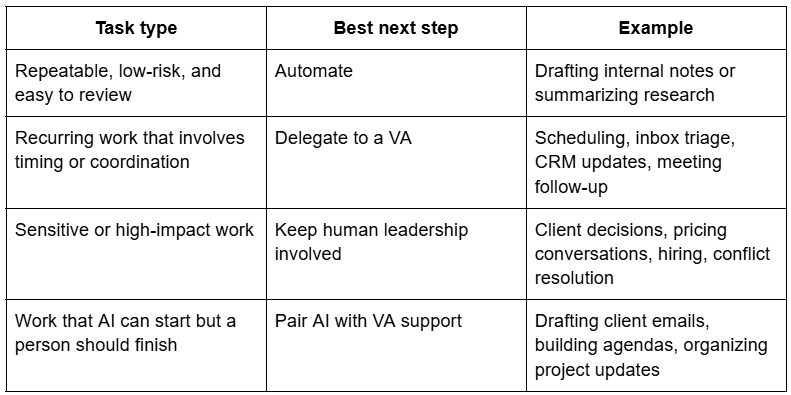
This filter gives you a cleaner way to decide where AI fits. It also keeps you from treating every task like a tech problem.
When a smaller business still needs a VA
Small business owners feel budget pressure first. You may look at AI and see relief. That makes sense.
Before you decide, look at the cost of the tasks you still carry. Do potential clients wait for a follow-up because your inbox is overwhelming? Does your calendar force you to context-switch all day? Do meeting notes sit untouched because no one owns the next step?
Those moments can cost you money and also cost energy. You may save on support for a month, only to lose the rhythm that made your business feel manageable.
A focused virtual executive assistant package can stabilize the highest-friction areas without forcing a full-time hire. Start narrow. Choose the inbox, calendar, meeting follow-up, or recurring admin. After 30 days, measure response time, open loops closed, and hours you reclaimed for leadership work.
AI can make the package more efficient. The VA makes it accountable.
Try this 30-minute delegation exercise
Open a blank page and create four columns: task, current owner, best support, and risk level.
List every recurring admin task you touched this week. Include the small things, like forwarding updates, finding links, rescheduling calls, cleaning up notes, preparing agendas, and checking whether someone replied.
Then mark each task as automate, delegate, or keep human. Circle anything that affects sales, clients, time, or relationships. Those tasks deserve attention first.
Choose five items for your first handoff. Give each item a clear owner, a simple standard, and a review point.
This exercise turns the vague AI vs virtual assistant question into a practical support plan. You stop guessing. You can see the work, the risk, and the relief available on the other side of a better handoff.
The support question leaders need now
AI gives founders useful leverage. You still need someone who understands context, notices what changed, and follows through when the calendar shifts or a client needs care.
Before you decide you no longer need a VA, give yourself a clearer view of the work. Automate the pieces that repeat. Delegate the work that needs ownership. Keep your leadership close to decisions that shape trust and growth.
Your time deserves a support system with judgment behind it. Smart tools can help. The right virtual executive assistant turns that help into follow-through, calmer weeks, and more space to lead.
Ready to get the right support in place? Schedule a consultation with She’s A Given to explore how a virtual executive assistant can support your workload, priorities, and leadership.
